CIT can broadcast your seminar, conference or meeting live to a world-wide
audience over the Internet as a real-time streaming video. The event can
be recorded and made available for viewers to watch at their convenience
as an on-demand video or a downloadable podcast. CIT can also broadcast
NIH-only or HHS-only content.
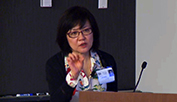
Dr. Li-Huei Tsai's main research interest is to decipher the molecular mechanisms underlying key neurological disorders that compromise cognition. Her research on cyclin-dependent kinase 5 (Cdk5) endeavors to illustrate how dysregulation of an essential protein kinase in neurons can lead to Alzheimer's-like neurodegeneration. Through studying Cdk5, Dr. Tsai uncovered molecular pathways involving DNA double-stranded breaks, cell cycle re-entry, and beta-amyloid peptides operating in the early stages of neurodegeneration that eventually lead to irreversible neuron death. Dr. Tsai created an inducible mouse model for hyperactivation of Cdk5 that manifests all of the key pathological features of Alzheimer's including beta-amyloid and tau pathology, massive neuronal loss and cognitive impairment in a short period of time. Using this mouse model, Dr. Tsai discovered a beneficial role for chromatin remodeling through inhibition of histone deacetylases (HDACs) in the recovery of learning and memory, even after substantial neuronal loss has occurred. Her work provides insights into the mechanisms underlying neurodegeneration associated with cognitive impairment and offers novel targets for therapeutic intervention of memory-related disorders.
Dr. Tsai was born in Taipei, Taiwan. She received her Ph.D. at the University of Texas Southwestern Medical Center. She completed her postdoctoral training at Cold Spring Harbor Laboratory and Massachusetts General Hospital. She joined the faculty at Harvard Medical School before moving to the Picower Institute for Learning and Memory at the Massachusetts Institute of Technology.
Selected Publications: Kim D, Frank C, Dobbin M, Tsunemoto R, Wu D, Peng P, Guan J, Lee B-H, Moy L, Gusti P, Broodie N, Mazitschek R, Delalle I, Haggarty S, Neve R, Lu Y, and Tsai L-H. Deregulation of HDAC1 by p25/Cdk5 in neurodegeneration. Neuron, 2008, 60, 803-817.
Kim D, Nguyen MD, Fischer A, Sananbenesi F, Dobbin MM, Rodgers JT, Delalle I, Baur JA, Sui G, Armour SM, Puigsrver P, Sinclair DA, Tsai L-H. SIRT1 deacetylase protects against neurodegeneration in models for Alzheimer's disease and amyotrophic lateral sclerosis. EMBO J, 2007, 26: 3169-3179.
Fischer A, Sananbenesi F, Wang X, Dobbin M, Tsai, L-H. Recovery of learning and memory is associated with chromatin remodeling. Nature, 2007, 447: 178-182.
Fischer A, Sananbenesi F, Pang PT, Lu B, Tsai L-H. Opposing roles of transient and prolonged expression of p25 in synaptic plasticity and hippocampus-dependent memory. Neuron, 2005, 48: 825-838.
Cruz JC, Tseng H-C, Goldman JA, Shih H, Tsai L-H. Aberrant Cdk5 activation by p25 triggers pathological events leading to neurodegeneration and neurofibrillary tangles. Neuron, 2003, 40: 471-483
Chromatin remodeling in neurodegeneration and neuronal repair [electronic resource] / Li-Huei Tsai.
Series:
Neuroscience seminar series
Author:
Tsai, Li-Huei. National Institutes of Health (U.S.)
Publisher:
[Bethesda, Md. : National Institutes of Health, 2009]
Other Title(s):
Neuroscience seminar series
Abstract:
(CIT): Dr. Li-Huei Tsai's main research interest is to decipher the molecular mechanisms underlying key neurological disorders that compromise cognition. Her research on cyclin-dependent kinase 5 (Cdk5) endeavors to illustrate how dysregulation of an essential protein kinase in neurons can lead to Alzheimer's-like neurodegeneration. Through studying Cdk5, Dr. Tsai uncovered molecular pathways involving DNA double-stranded breaks, cell cycle re-entry, and beta-amyloid peptides operating in the early stages of neurodegeneration that eventually lead to irreversible neuron death. Dr. Tsai created an inducible mouse model for hyperactivation of Cdk5 that manifests all of the key pathological features of Alzheimer's including beta-amyloid and tau pathology, massive neuronal loss and cognitive impairment in a short period of time. Using this mouse model, Dr. Tsai discovered a beneficial role for chromatin remodeling through inhibition of histone deacetylases (HDACs) in the recovery of learning and memory, even after substantial neuronal loss has occurred. Her work provides insights into the mechanisms underlying neurodegeneration associated with cognitive impairment and offers novel targets for therapeutic intervention of memory-related disorders. Dr. Tsai was born in Taipei, Taiwan. She received her Ph.D. at the University of Texas Southwestern Medical Center. She completed her postdoctoral training at Cold Spring Harbor Laboratory and Massachusetts General Hospital. She joined the faculty at Harvard Medical School before moving to the Picower Institute for Learning and Memory at the Massachusetts Institute of Technology. For more information see our website - http://neuroseries.info.nih.gov.